

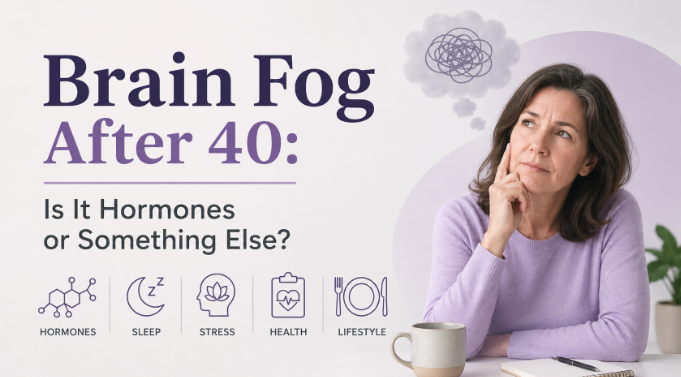
She used to walk into a room and know exactly why she was there. She used to hold three threads of a conversation simultaneously without losing any of them. She used to read a page and remember what it said.
At 43, she reads the same paragraph twice and still can’t quite hold onto it. She walks into the kitchen and stands there. She forgets words mid-sentence. She knows she’s not stupid. She’s frightened it might be something serious. Her doctor ran a few labs and called her normal.
Brain fog after 40 is one of the most distressing symptoms women describe during perimenopause, and one of the most dismissed. “You’re just stressed.” “It’s a busy season.” “You’re getting older.” These explanations feel insulting precisely because they’re incomplete.
Sometimes brain fog is hormonal. Sometimes it’s something else entirely. Often, it’s both at once.
The Hormonal Explanation
Estrogen doesn’t just affect the reproductive system. It influences the brain.
Estrogen receptors are distributed throughout the central nervous system. Estrogen affects neurotransmitter function, supports cerebral blood flow, and plays a protective role in the brain’s energy metabolism. When estrogen fluctuates or declines, the brain notices.
The connection between estrogen and cognitive clarity isn’t well-publicized, but it’s real. Women in perimenopause frequently report that the brain fog comes and goes in a way that tracks with their cycle, or that it worsened noticeably after their periods became irregular. That pattern is a signal worth taking seriously.
Progesterone also matters here. Progesterone converts to a neurosteroid called allopregnanolone, which has calming, anti-anxiety effects on the brain. When progesterone drops, anxiety often rises. Anxiety and cognitive clarity are inversely related. It’s very hard to think sharply when the nervous system is running in low-grade alarm mode.
And testosterone, which women often forget they have and need, supports overall drive, motivation, and mental clarity. Women describe this specific quality: the absence of testosterone isn’t just fatigue. It’s a flat, unengaged relationship with their own thinking. They’re not depressed exactly. They just don’t feel sharp. Nothing interests them the way it used to.
The Non-Hormonal Contributors That Often Get Missed
Hormones don’t cause every case of brain fog. Several other mechanisms, many of which intersect with hormonal health, contribute.
Sleep deprivation is the most direct. The brain consolidates memory, clears metabolic waste, and restores function during sleep. When sleep is disrupted, and perimenopausal sleep disruption is very common, cognitive function suffers in measurable ways. A woman running on five broken hours of sleep will experience word-finding difficulties, reduced working memory, and slower processing whether or not her hormones are in balance.
Thyroid dysfunction is another major and frequently missed contributor. The thyroid regulates energy metabolism at the cellular level. Suboptimal T3, the active thyroid hormone, reduces ATP production in brain cells. The result is a brain that can’t generate enough energy for sharp function. Conventional thyroid testing often misses this because it only checks TSH, not free T3. A woman can have a TSH that looks normal while her T3 is quietly dragging.
The gut-brain connection adds another layer. An imbalanced gut microbiome drives systemic inflammation. That inflammation doesn’t stay in the digestive tract. It reaches the brain and creates what researchers now call neuroinflammation, a low-grade inflammatory state in the central nervous system that directly impairs cognitive function. This is the mechanism behind the observation that many people with poor gut health also experience poor mental clarity.
Nutrient deficiencies, particularly iron stores (ferritin), vitamin D, and B vitamins, affect cognitive function directly. Low ferritin causes fatigue and brain fog that can look exactly like hormonal dysfunction. Deficient vitamin D, extremely common in northern climates, is associated with cognitive impairment and mood disturbance. These are testable and correctable, but they require testing that goes beyond a standard annual panel.
Why “It’s Just Aging” Isn’t Good Enough
The “you’re getting older” explanation is frustrating for a reason. It’s not wrong to say that cognitive function can change with age. It’s wrong to stop there.
Biological aging and the specific type of cognitive decline that comes from hormonal disruption, sleep deprivation, thyroid insufficiency, or inflammation are not the same thing. One is a slow, gradual process with a specific character. The others are conditions with identifiable causes that respond to targeted intervention.
A woman who addresses her hormone imbalance, optimizes her thyroid, fixes her sleep, and reduces inflammatory burden can experience a return of cognitive clarity that feels, to her, like getting a piece of herself back. That’s not reversing aging. That’s removing obstacles that were suppressing the function that was always there.
The risk of accepting “it’s just aging” is that treatable causes go untreated for years. Those years matter, both for quality of life and for long-term brain health. Maintaining estrogen levels during the perimenopausal transition has documented associations with reduced dementia risk later in life. The brain benefits of early hormone optimization are preventive, not just symptomatic.
What a Thorough Evaluation Looks Like
Evaluating brain fog thoroughly means looking at multiple systems, not just one.
A comprehensive panel includes full thyroid (not just TSH), sex hormones (estradiol, progesterone, testosterone, SHBG), adrenal markers (cortisol rhythm, DHEA), ferritin, vitamin D, and basic inflammatory markers. Each of these can independently produce brain fog, and several often show up together.
The Dutch test adds useful information about cortisol rhythm across the day, progesterone metabolites, and estrogen metabolism pathways. Gut testing can reveal microbiome imbalances driving inflammation. The picture these tests paint together is far more useful than any single marker.
From a hormonal standpoint, if estrogen is declining and the woman is in the perimenopausal window, bioidentical hormone therapy can restore cognitive clarity in a way that goes beyond symptom management. Women consistently describe this as one of the most meaningful improvements, feeling like themselves again mentally, not just physically.
The DHEA Connection
DHEA, produced by the adrenal glands, is a precursor hormone that feeds into both estrogen and testosterone production. Chronic stress is the primary driver of low DHEA. When DHEA is depleted, the raw material for making those downstream hormones is compromised.
Women under significant long-term stress, which describes a substantial portion of women in their 40s, often have DHEA levels that are lower than their age would predict. Testing DHEA sulfate (DHEA-S) is simple and informative. When levels are suboptimal, targeted supplementation under clinical guidance can support both adrenal function and downstream hormone balance.
This is another place where conventional medicine rarely looks but functional medicine routinely does.
When to Be Concerned About Something Else
Not all cognitive changes after 40 are hormonal. It’s worth naming that clearly.
If cognitive symptoms are severe, rapidly progressive, or accompanied by personality changes, significant memory gaps, or confusion about time and place, those symptoms warrant evaluation by a neurologist. Functional medicine doesn’t replace that evaluation. It complements it.
What functional medicine addresses is the large category of women who sit well below that threshold: who are struggling cognitively in ways that affect daily function, who have been told their labs are normal, and who haven’t had the hormonal, thyroid, adrenal, and nutritional picture assessed comprehensively.
That category is large. And the causes, when found and addressed, are often treatable.
What Women Report After Treatment
Women who address hormonal brain fog through comprehensive evaluation and treatment consistently describe the same sequence. Within a few months of optimizing estrogen, progesterone, and in many cases testosterone, they notice they can hold conversations without losing the thread. They can read and retain. They can walk into a room and remember why they’re there.
It doesn’t come back overnight. The hormonal picture takes time to stabilize. But the trajectory is clear, and for women who have been living with diminished cognitive function and no explanation, finally having both a diagnosis and a path forward is a significant relief.
About the Author: Dr. Sasha Rose is a naturopathic physician and licensed acupuncturist at Med Matrix, a functional medicine clinic in South Portland, Maine. She specializes in women’s hormone health, bioidentical hormone therapy, and root-cause approaches to perimenopause and menopause.